
kaznu
Sociology
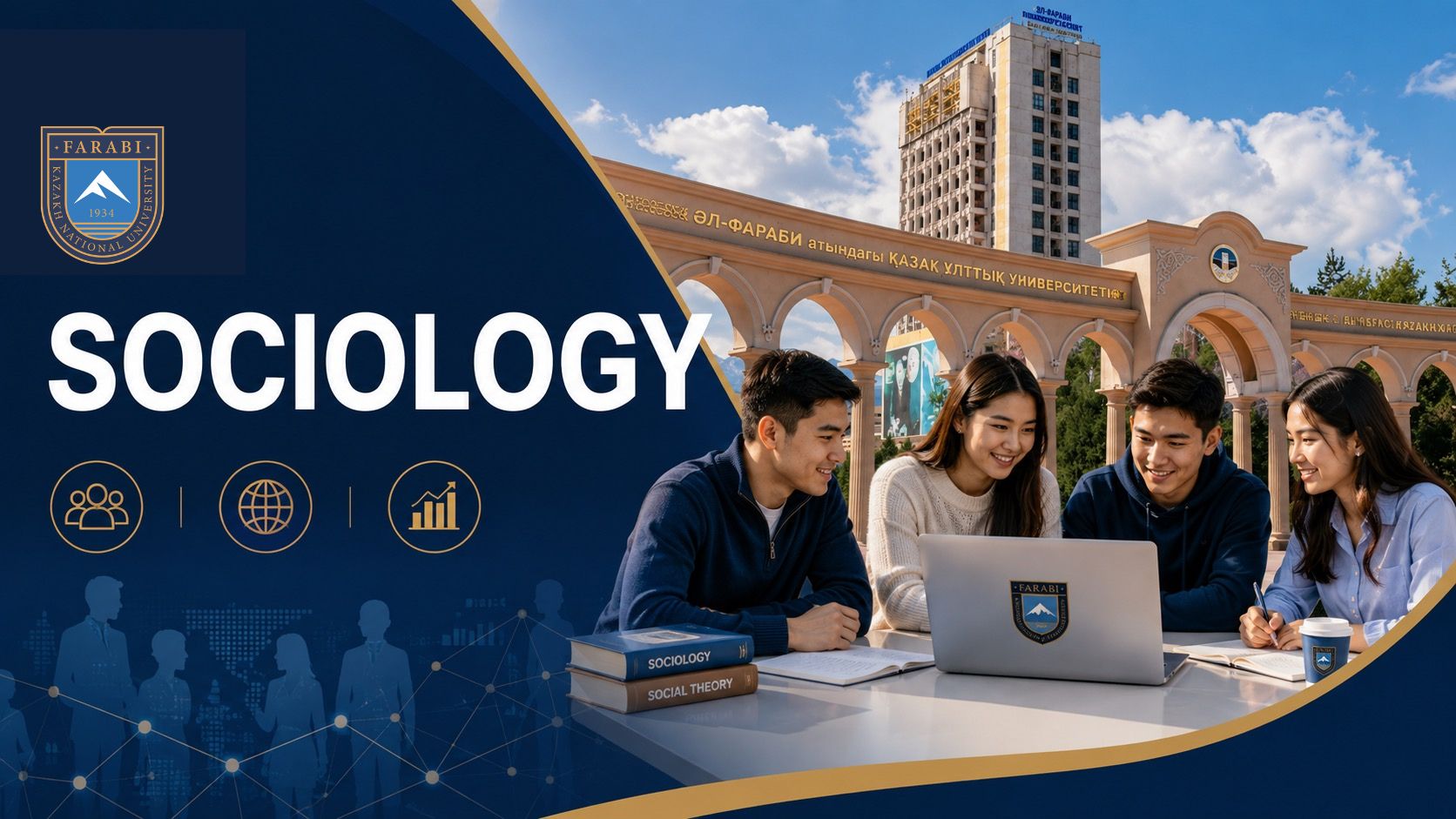
Brief Course Description
Sociology provides a systematic understanding of society, social relations, institutions, and the processes that shape human behavior. The course develops students’ sociological imagination, critical thinking, and research skills, enabling them to analyze social problems and evaluate programs designed to address them.
The course introduces classical and contemporary sociological theories associated with leading international and Kazakhstani scholars. It covers a broad range of topics, including social inequality, identity, family, youth, religion, culture, ethnicity, education, mass media, globalization, labor, health, urbanization, social movements, and social change.
By studying sociological concepts and research methods, students will learn to examine the relationship between individuals and society and explore such questions as:
- To what extent are individuals free in their choices?
- Why does social inequality exist?
- How do people and social institutions interact?
- How do family background, ethnicity, social class, religion, and gender influence people’s lives? What causes conflict and social change?
The course combines theoretical learning with situational tasks, interactive exercises, discussions, educational games, films, videos, research assignments, presentations, and tests.
Course Structure
Week 1. Sociology in the understanding of the social world
Week 2. Introduction to the sociological theory.
Week 3. Sociological research.
Week 4. Social structure and stratification.
Week 5. Socialization and Identity.
Week 6. Family and modernity.
Week 7. Youth and society.
Week 8. Religion, culture and society.
Week 9. Sociology of ethnicity and nation.
Week 10. Education and social inequality.
Week 11. Mass-media, technologies and society.
Week 12. Economy, globalization and labor.
Week 13. Health and medicine.
Week 14. Population, urbanization and social movements.
Week 15. Social changes: newest sociological discussion.
Academic presentation of the course
Aim of the Course
To form students' ability to evaluate solution programs of social problems based on sociological imagination, critical thinking and methods of sociological research for the analysis and interpretation of social processes and institutions.
Expected Learning Outcomes (LO)
LO 1 - to explain the categories of sociology, trends in the development of society on the basis of sociological macro- and micro-theories and concepts.
LO 2 - to interpret social reality based on sociological imagination and critical thinking.
LO 3 - to apply sociological methods and theoretical constructs to develop research design and analyze specific social problems.
LO 4 - to analyze the features and interrelation of social processes (socio-economic, political, cultural) and social institutions from the position of a sociological perspective and the value system of Kazakhstani society.
LO 5 - to summarize information on trends in the development of social structures, individual and family, economy, education, culture, religion, social communications and globalization based on comparative research.
LO 6 - to evaluate programs for solving social problems and situations in own professional fields based on socio-ethical values.
Indicators of LO achievement (ID)
IA 1.1 - to interpret the basic categories of sociology: social groups, institutions, structures, processes, etc.
IA 1.2 - to determine the interrelation between the theoretical and empirical level of sociology, macro- and micro- approaches.
IA 1.3 – to contextualize basic sociological ideas based on reading sociological works, highlighting local and global trends in the development of modern society.
IA 2.1 - to identify the interrelation of social and personal problems to understand the features of social reality.
IA 2.2 - search for information to analyze social situations and search for their solutions.
IA 2.3 - to argument the importance of social values for understanding the surrounding social reality and organizing professional activities.
IA 3.1 - to formulate an urgent problem, the goal and objectives of the research.
IA 3.2 – to compose a sociological research program (problem, tasks, hypotheses, concepts, etc.)
IA 3.3 – to justify the choice of the method and sample of the research.
IA 3.4 - to develop research tools for analyzing a specific social problem.
IA 4.1 - to differentiate the characteristics of social, economic, political, cultural processes.
IA 4.2 - to analyze the dynamics, changes and functions of social institutions (family, state, education, religion, market and others) in modern society.
IA 4.3 - to illustrate the role of social values, norms in the integration of social groups and society as a whole.
IA 5.1 – to use sources of social information: statistical and sociological data, mass media, scientific publications, reports of organizations and others to study social problems.
IA 5.2 - to compare trends in the development of social groups, structures and institutions in a local and global perspective.
IA 5.3 - to analyze social development programs of Kazakhstani society.
IA 5.4 – to develop proposals to improve situations in the social, political, cultural, economic spheres.
IA 6.1 - analyze the collected social information in a scientific report and presentation.
IA 6.2 - to discuss recommendations, solutions of social problems and situations based on social and ethical values.
IA 6.3 - develop a roadmap, models for solving social problems.
Course Authors
 |
Gulmira ABDIRAIYMOVAGulmira ABDIRAIYMOVA is a Doctor of Sociological Sciences, Professor, Head of the Department of Sociology and Social Work at Al-Farabi Kazakh National University. She is the author of more than 300 scientific publications, including articles in international journals indexed in Web of Science and Scopus. She serves as a principal investigator for research grants of the Ministry of Science and Higher Education of the Republic of Kazakhstan and coordinates several international projects, including a capacity- building initiative in social work with The Hong Kong Polytechnic University (2024-2029), as well as Erasmus+ collaborations (Vrije Universiteit Amsterdam and others). Her research interests include the sociology of religiosity, spirituality, well-being and youth identity, sociology of education and science, and applied sociological research. She supervises master’s and doctoral dissertations, chairs the Dissertation Council on “Social Sciences and Education”. Director of the Center for Sociological Research and Social Engineering at Al- Farabi Kazakh National University.. |
 |
Dana BURKHANOVADana BURKHANOVA received her MA in Sociology from the Paris-Sorbonne University (Sorbonne Université) and her PhD in Sociology from the al-Farabi Kazakh National University in 2014. Her dissertation is entitled “Values and economic strategies of middle class in Kazakhstan”. Currently is an Instructor in the Department of Sociology and Anthropology at Nazarbayev University. Her research interests include social inequality, education, values, youth and social policy. She has participated in various research, policy analysis and consulting projects with UNICEF, UNDP, Konrad Adenauer Stiftung, Friedrich Ebert Stiftung, and the governmental bodies of the Republic of Kazakhstan. Her scholarly publications include articles in both national and international journals. |
 |
Tatyana LIFANOVATatyana LIFANOVA is a Candidate of Philosophical Sciences and an experienced researcher at Al-Farabi Kazakh National University. Since 2013, she has been a member of the Educational and Methodological Association (UMO RUMS) in the field of Philosophy; since 2022 - Chair of the Academic Committee of Al-Farabi KazNU in the field of Humanities. She contributed to the development of national educational standards (GOSO), curricula, and model syllabi in Philosophy. Since 2006, she has participated as PI, co-investigator or researcher in more than 30 scientific projects funded by the Ministry of Science and Higher Education of the Republic of Kazakhstan, UNESCO, and etc. She is the author of more than 200 scientific works, including monographs, textbooks, and articles published in Scopus and Web of Science indexed journals. |
 |
Aruzhan SAIMASSAYEVAAruzhan SAIMASSAYEVA, PhD, is an Instructor in the Department of Sociology and Social Work at Al-Farabi Kazakh National University and a Research Fellow at The Hong Kong Polytechnic University - Al Farabi Kazakh National University Centre for Sustainable Development in Central Asia. She completed a research internship at the Centre for Religious and Cultural Studies within the Faculty of Social Sciences at the University of Ljubljana, Slovenia. Her research interests include youth studies, the sociology of religion, well-being, qualitative research methods, sustainable development, and the application of artificial intelligence in social work and education. Aruzhan serves as a Co-Principal Investigator and Co-Investigator in international research projects conducted in collaboration with The Hong Kong Polytechnic University in Hong Kong, the University of Calgary in Canada, and other international partner institutions. |